



Two minutes and seventeen seconds.
That’s how long a group of explorers stood under an ominous light of darkness. This paradoxical and temporary moment where a Greenlandic sky revealed shades I’d never witnessed before.
Two minutes and seventeen seconds.
That’s also how long I had to document a moment that I had no experience with. It was something I’d spent weeks preparing for, but if I’m being honest, I still wasn’t sure how the final visual story’d play out.
Here I was, in the deepest fjords of East Greenland, on the top deck of a small ship with two tripods, two cameras, and two minutes and seventeen seconds. I needed a specific image. An image that could convey the gravity, wonderment, and contradictory nature of what I was about to experience.

In the summer of 2026, I got to experience first-hand just how special a total solar eclipse is, and in this story, I’m going to share my journey in bringing this image to life.
An Opportunity At Wonderment
A few weeks after returning from an assignment in Svalbard, I received a call about returning to the Arctic Circle. Only this time, it’d be aboard another vessel that was travelling to East Greenland in an effort to witness a total solar eclipse.
I’m not an astrophotographer. I’ve never witnessed an eclipse of any kind. And truthfully, I never had a desire to seek one out. That being said, 2026 was a big year for space and sci-fi. Experiencing the double-feature of _Project Hail Mary_ in IMAX and the Artemis II launch had reinvigorated my love for the cosmos. So when I got the call for an opportunity to document a total solar eclipse in East Greenland, my creativity had been primed for a story unlike any other I had done before.
Now, there was a looming danger of potentially damaging the sensors of my cameras, so I made an effort to devour as much information as I could find about photographing an eclipse. It was overwhelming, but to my delight, incredibly easy to execute once you have the necessary pieces. So I began packing the usual kit I travel to the polar regions with, only this time, I made sure to include specialty filters and glasses for the eclipse (more on this later).

I’ve heard many people share their experience of viewing an eclipse and how profound it can feel. The more I researched, the more excited I got. I learned that while a total eclipse isn’t that rare, occurring on average once every 16 months, the chance of one happening in the same region is much more scarce. For example, Greenland hasn’t seen a total solar eclipse in 18 years, and that was in the far northern outskirts of the island.
I should also mention that a total solar eclipse is far different from a partial eclipse. We’ve seen no shortage of images where the moon partially covers the sun. It makes for a very Instagrammable moment. But there’s no image that can convey the astounding and epic proportions of witnessing a **total** solar eclipse.
This adventure was going to be special.
What had me especially excited was that this trip was going to take place with Quark Expeditions alongside their elite expedition team.
Setting Up For Success
If you want to go fast, you go alone. If you want to go far, you go as a team.
It’s a well-known African proverb, and one that perfectly embodies my experience travelling with the Quark team over the years. Booking a flight to a planned location to view an eclipse could make for a quicker journey, but it wouldn’t have had the depth and meaning of the one I’d embarked on.

First, we had Amalia Goodall, an incredible Expedition Leader with nearly two decades of experience under her belt and a calm conviction that made us all feel like we were in capable hands. Around her was a stacked squad of expedition guides that brought a wealth of information from all corners of the expeditioning world. From Ross Day and his deeply informed historical accounts of the region, to Ema Kuhn and her expertise in marine biology, or even Marcos Couch with decades of mountaineering experience, there was no shortage of expertise on this ship.
For this voyage, we also had a special guest that’d help us court success.

Joining our expedition was Michael Zeiler, an eclipse cartographer and solar eclipse expert. He’s spent decades researching, mapping, and generously sharing a wealth of information about eclipses. I got to spend valuable time just picking his brain, looking to absorb whatever I could to arm myself for the experience we were about to share. I couldn’t help but feel confident that with Michael by our side, I’d be able to get useable shots.
Importantly, our entire crew would be embarking on this voyage on a small but well-equipped vessel. Therein lay another incredible advantage.
An Itinerary That Bent
Our expedition would be a 17-day voyage that started in Reykjavik, crossed the Denmark Strait, and explored East Greenland—taking in the eclipse event in between—before docking in Nuuk. While much of the itinerary was planned, the beauty of being on a ship like this meant that we could pivot and maneuver depending on what the external conditions were.

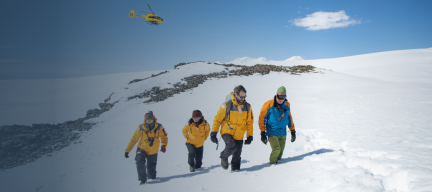
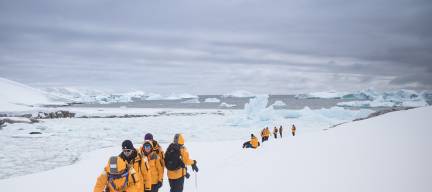
We were able to bend our itinerary to maximize our time in East Greenland, soaking in the history and beauty of the region. Further, we could navigate to places that you just couldn’t get to by other means. There was one afternoon where we got to cruise our Zodiacs around Maria Island, a geological marvel that sat within Northeast Greenland National Park. Let me tell you, the colours and textures of this place were unlike those I’d ever seen before.

The advantages of our ship, the Ocean Explorer, would prove to be crucial as weather conditions kept shifting as we neared the eclipse date. We’d made a decision to venture to Scoresby Sound, the largest and deepest fjord system in the world, to witness the event. The monstrous mountains and vast valleys of this region had a way of managing clouds, which would come in handy.
We had Plan A, which had to be abandoned for Plan B. But as updated weather models arrived, we needed to develop Plan C. Amalia and Michael, along with a cohort of experts on other vessels in the region, would come up with a solution that we could safely commit to. One that’d give us the highest likelihood of witnessing the total solar eclipse with next to no cloud cover.
Their hard work paid off.
Taking The Shot
At 3:00 PM East Greenland Time, with our ship situated at 70° 54.4′ N, 027° 55.2′ W within Scoresby Sound, we were ready to witness the eclipse. This otherworldly event that had pulled nearly 100 other explorers to this very voyage was 30 minutes away, and I was methodically laying out my gear on the very top deck to document it.
I had one camera dedicated to photos and the other dedicated to video. Both were outfitted with telephoto lenses and specialty solar filters that could cut 20 stops of light. Remember our sun? It’s very bright, so these solar filters are needed to reduce the amount of light passing through so we can get a useable image and critically, not damage our camera sensor.

I’d pre-focus the cameras to infinity, then tape down the focus rings on the lenses while ensuring my cameras remained in manual focus mode. This meant that the sun would, save for any accidents, remain in focus for all the shots.
The process was simple: during the partial phases of the eclipse, both before and after, the filters stayed in front of the lens to capture a usable photo and protect our sensors. During totality, the two minutes and seventeen seconds of total eclipse, I’d remove the filter to capture crucial shots.

With respect to settings, I’d look to keep the ISO of my camera as low as possible to preserve details and dynamic range. The aperture would be quite narrow, but since I was on a tripod and a relatively steady ship, the shutter speed could land comfortably around 1/125 of a second. In all my research, there were a lot of recommendations for settings. The settings I had didn’t match the most common answers. But I decided to adapt to the lenses I had and pushed for results that’d maintain the most colour information possible.
At the recommendation of our local eclipse expert, I would shoot in a bracketed mode that would capture five images with each shutter press, each image at a slightly different exposure level. This meant that I could choose the best from five options in the editing process for the ideal starting point.
With the gear in place and the event beginning, it was time to start documenting.
Dread & Elation
As a photographer, I share this honestly and humbly: there’s no photograph that can encapsulate the jaw-dropping, multidimensional experience of a total solar eclipse into a two-dimensional medium.
At 100% coverage, the sky is filled with an eerie darkness that’s unlike anything you’ve ever experienced. There’s a sudden sharp chill in the air that feels like a Dementor draining the life out of you. All the markers culminate into something that feels like markers of the apocalypse.
And yet, we’ll be okay.

The science tells us we’ll be okay, so we witness these doom-like conditions with a human arrogance that we’ll be okay, and as a result, elation fills our system. There’s a signal overload, external and internal, colliding within us into a hurricane of emotions that express themselves in a multitude of ways.
Cheers. Tears. Laughter. Dance.

There’s nothing I could’ve done to emotionally prepare myself for a total solar eclipse. There’s just nothing like it.
Reflections From An Epic Adventure
I’ll say again, it’s impossible to package the emotional weight of a total solar eclipse into an image. Nowadays, we’re flooded with images from eclipse events all over the world and so many of them are beautiful to look at. But none, and I say this humbly, put you there. So it begs the question: why go through all this effort to take a photo that’ll never do the real thing justice?
Because we can.

The beauty of all of this effort was to have a frame to call my own. A frame that could serve as proof that I’d made this journey because I could. As a photographer, it’s an immense privilege to travel the world with a camera by my side. This eclipse… This astounding natural event… It gave birth to a visual record that could live in my archive as proof that I didn’t let this privilege go to waste.

About the Author: Gajan Balan is a photographer and director based in Toronto, and a Leica Camera ambassador. His work spans portraiture, fashion, street, and documentary, and has been recognised with multiple awards, gallery exhibitions, and publications.


